

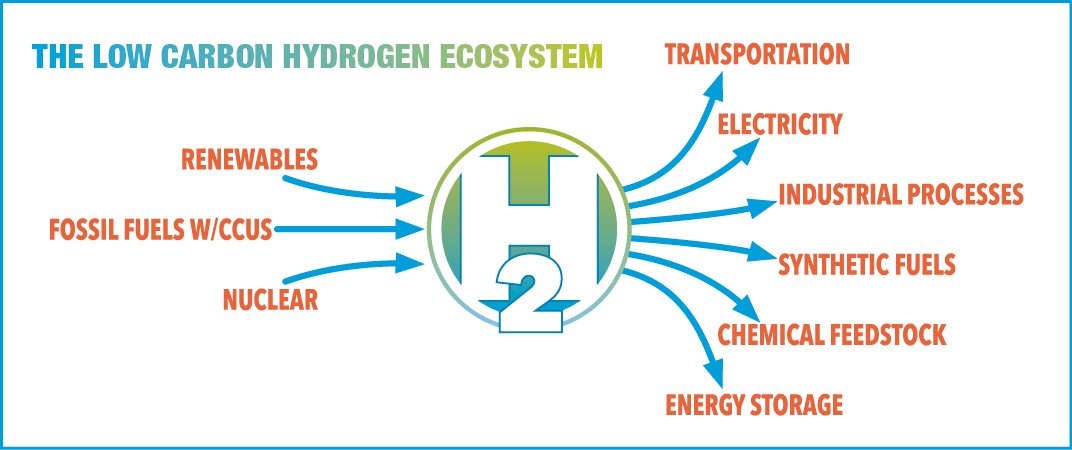
LCH can be produced from a diverse range of low-CO2 energy sources. Its potential supply includes production from fossil fuels combined with CO2 capture, use and storage (CCUS), low-emission electricity, biomass, and biomethane.
Clean Hydrogen Basics
CHFC's guide to understanding clean hydrogen technologies and their potential for transforming our energy landscape.
Hydrogen is a Valuable Energy Asset
Hydrogen Production Technologies
Transport, Delivery, and Storage
Low carbon hydrogen (LCH) can be used to store, move, and deliver low-carbon energy to where it is needed. It can be transported as a gas by pipelines or in liquid form by ships, much like liquefied natural gas (LNG). It can be stored as a liquid, gas, or chemical compound such as ammonia.
Diverse Applications Across Industries
The use of LCH is growing across a wide range of applications and has the potential for significant future demand, including in export markets. LCH can be used as a feedstock or a replacement fuel in a number of industries, including petroleum refining, ammonia for fertilizer production, food and pharmaceutical production, metal and steel manufacturing, and in nearly all forms of transportation (including air, ship and rail). LCH can also be converted to energy through engines, turbines, and fuel cells. LCH is one of the leading options for storing low carbon energy and can as it can be stored onsite and can be use to provide firm electricity to fuel the growth of AI and data centers.
Hydrogen Insights
Explore detailed graphics explaining hydrogen technologies and applications.
Lorem Ipsum
Lorem ipsum dolor sit amet, consectetur adipiscing elit, sed do eiusmod tempor incididunt ut labore.

Lorem Ipsum
Duis aute irure dolor in reprehenderit in voluptate velit esse cillum dolore eu fugiat nulla pariatur.

Lorem Ipsum
nostrud exercitation ullamco laboris nisi ut sunt in culpa qui officia deserunt mollit anim id est laborum.

Dive Deeper Into Hydrogen
Connect with our experts to learn more about clean hydrogen technologies and opportunities.